
Where does your EV energy actually go?
Traditional vehicle trip computers report a single opaque average like 18.5 kWh/100 km.
Exergy reads raw vehicle bus telemetry directly from the Android Car API and attributes energy consumption to its fundamental physical and environmental causes: aerodynamic drag, tire rolling resistance, climate HVAC, and elevation work.
The flaw in the 18.5 kWh/100 km trip computer
When an EV trip consumes 24 kWh/100 km instead of the rated 17, typical car dashboards blame the driver. They provide zero visibility into whether the loss was caused by high aerodynamic drag from a 40 km/h headwind, cold battery preconditioning, sub-zero cabin heating, tire rolling resistance, or 800 meters of vertical mountain climb.
A single black-box number computed by dividing total battery discharge by distance travelled. Gives no physical explanation, no actionable insight into aerodynamic speed penalties, and no separation between vehicle propulsion and cabin thermal comfort.
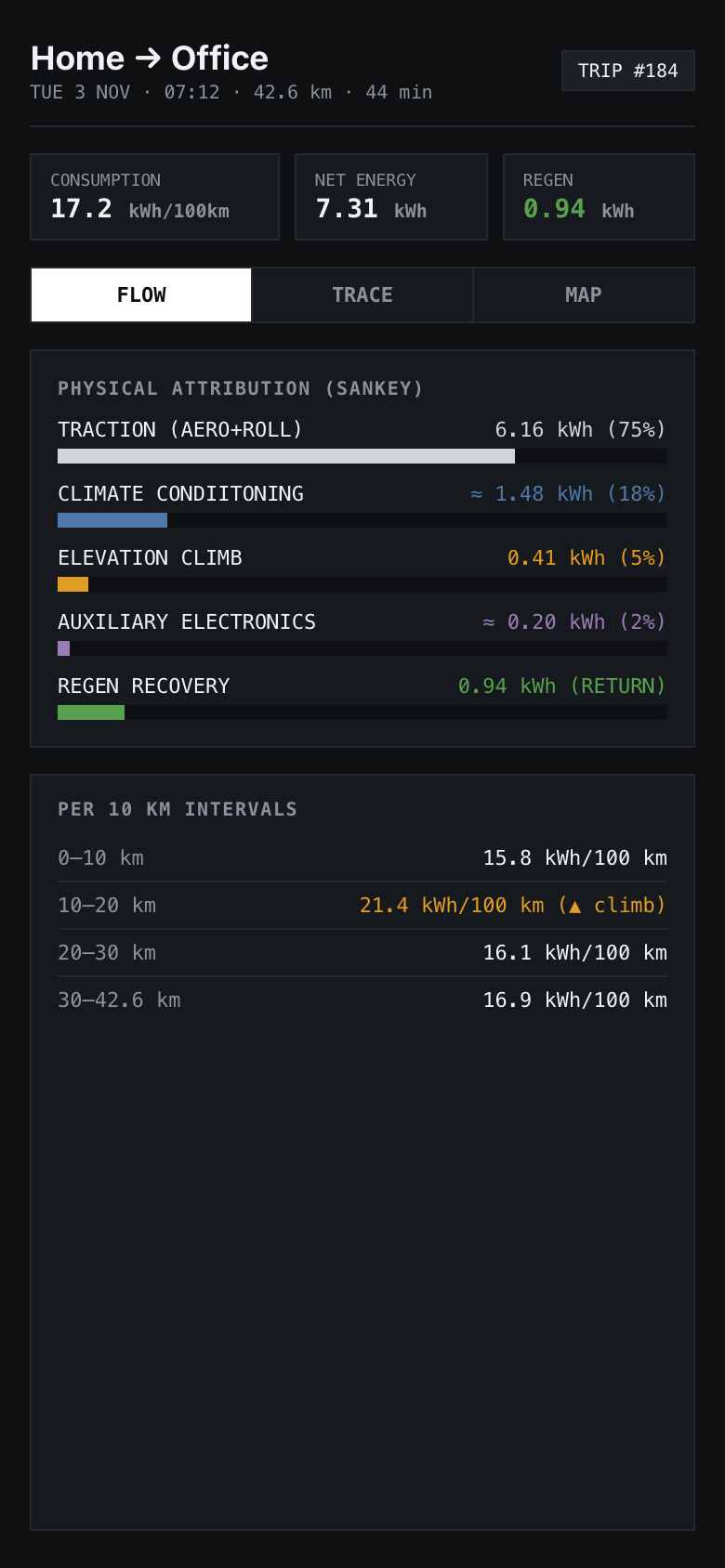
Decomposed into physical energy sinks: 12.1 kWh/100 km aero drag, 3.4 kWh/100 km tire roll, 4.8 kWh/100 km cabin heat pump, 3.2 kWh/100 km mountain pass climb, 0.3 kWh/100 km 12V bus, minus 2.1 kWh/100 km kinetic regen recaptured.
Scales with the cube of vehicle velocity. Exergy applies continuous ambient air density corrections based on barometric pressure and outside temperature, allowing drivers to isolate headwind effects from speed increases.
Calculates the thermal coefficient of performance (COP) of the vehicle's heat pump or PTC heater. Isolates cabin conditioning from battery thermal preconditioning, proving exactly how much winter range is lost to heating.
Attributes energy spent lifting the vehicle's mass against gravity versus potential energy stored. Separates grade climb consumption from rolling drag and calculates true round-trip descent recovery.
Directly tracks kilowatt-hours recovered back into the high-voltage pack during blended friction or one-pedal deceleration. Reports mechanical-to-chemical conversion efficiency and warns when cold battery limits braking regen.
Monitors the DC-DC converter output feeding vehicle ECUs, driver assist radars, exterior lighting, sound system, and displays. Reveals parasitic consumption while driving and in stationary stop-and-go traffic.
Tracks high-voltage battery loss when the car is parked, asleep, or running battery thermal protection in freezing temperatures. Provides verified overnight percentage loss without guessing.
One telemetry engine across every surface
Designed specifically for Android Automotive OS head units (Google built-in) and companion mobile apps. Compliant with Google Play automotive driver-distraction safety rules while driving, with full engineering depth when parked or on your phone.
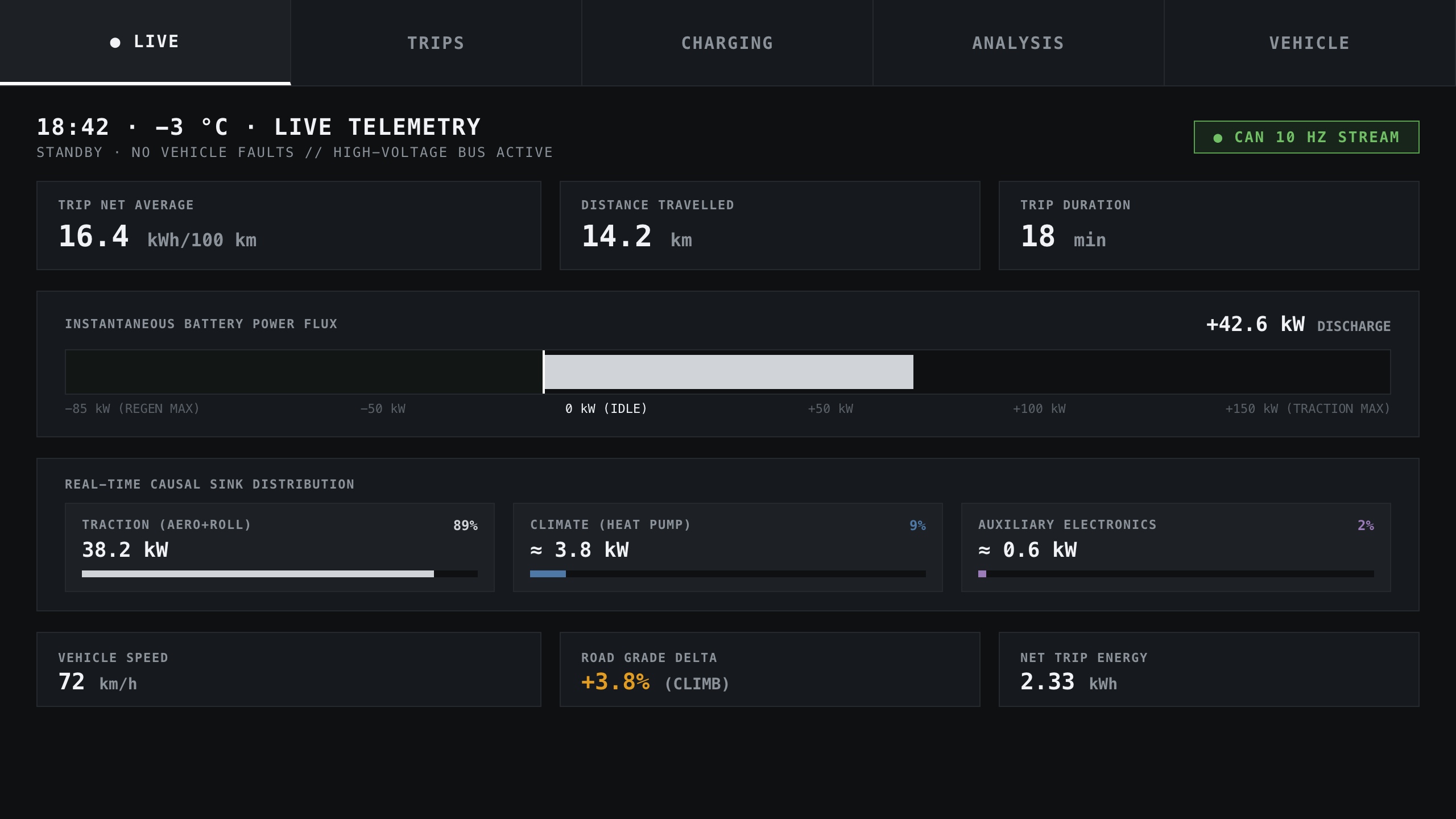
Glanceable telemetry while driving
While moving, driver distraction rules (Driver Optimization - DO) require minimal cognitive load. Exergy displays a high-contrast bipolar power gauge (-150 kW to +300 kW), instantaneous kW sink distribution, and grade compensation delta with high-legibility tabular figures and minimum 76 dp touch targets.
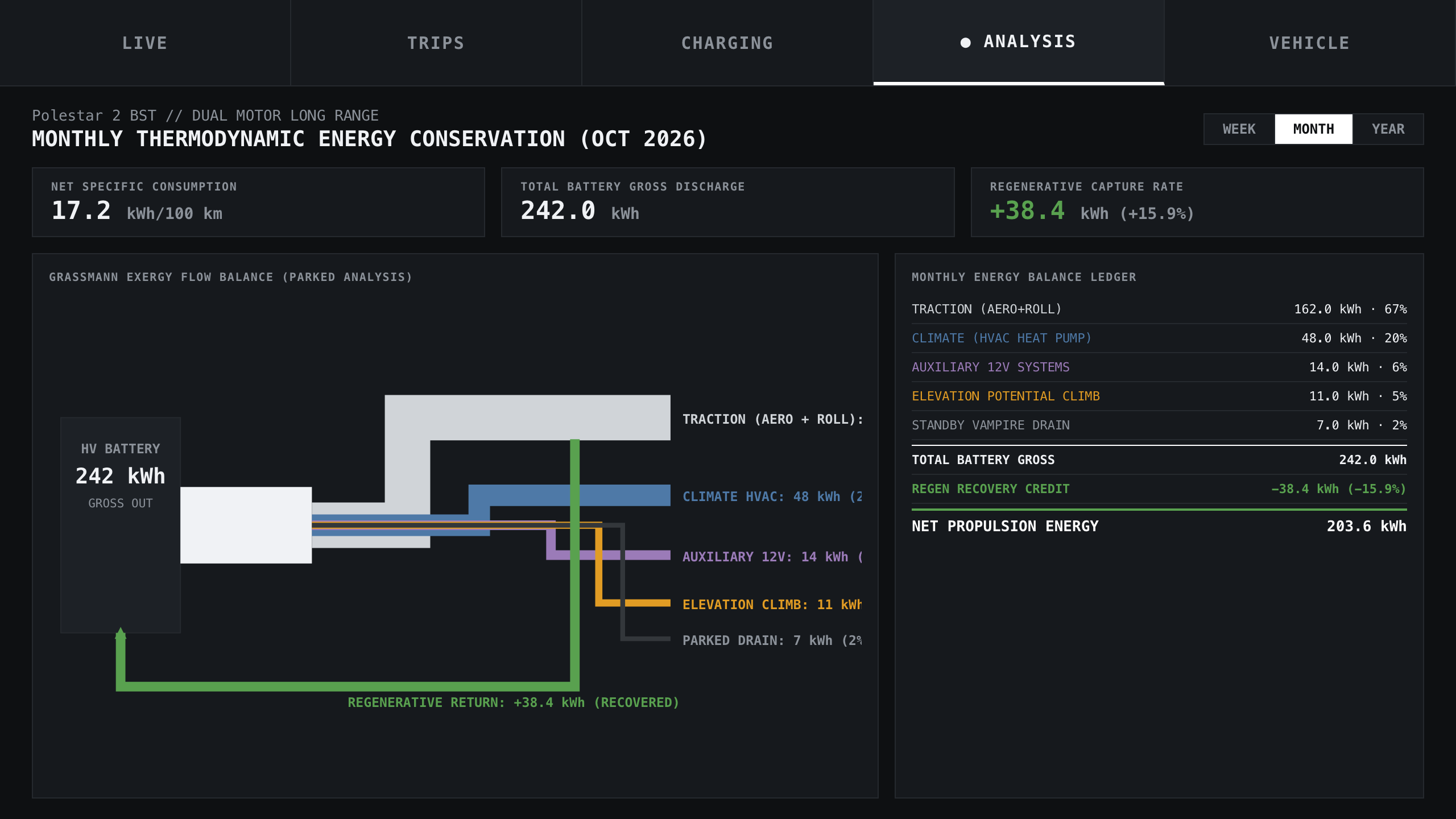
Full thermodynamic Sankey balance in park
Once the vehicle shifter enters PARK, Exergy transitions seamlessly into full interactive analysis mode. Inspect the complete monthly Grassmann energy flow balance, correlation scatter plots linking efficiency directly to outdoor temperature, and historical trip efficiency ladders.
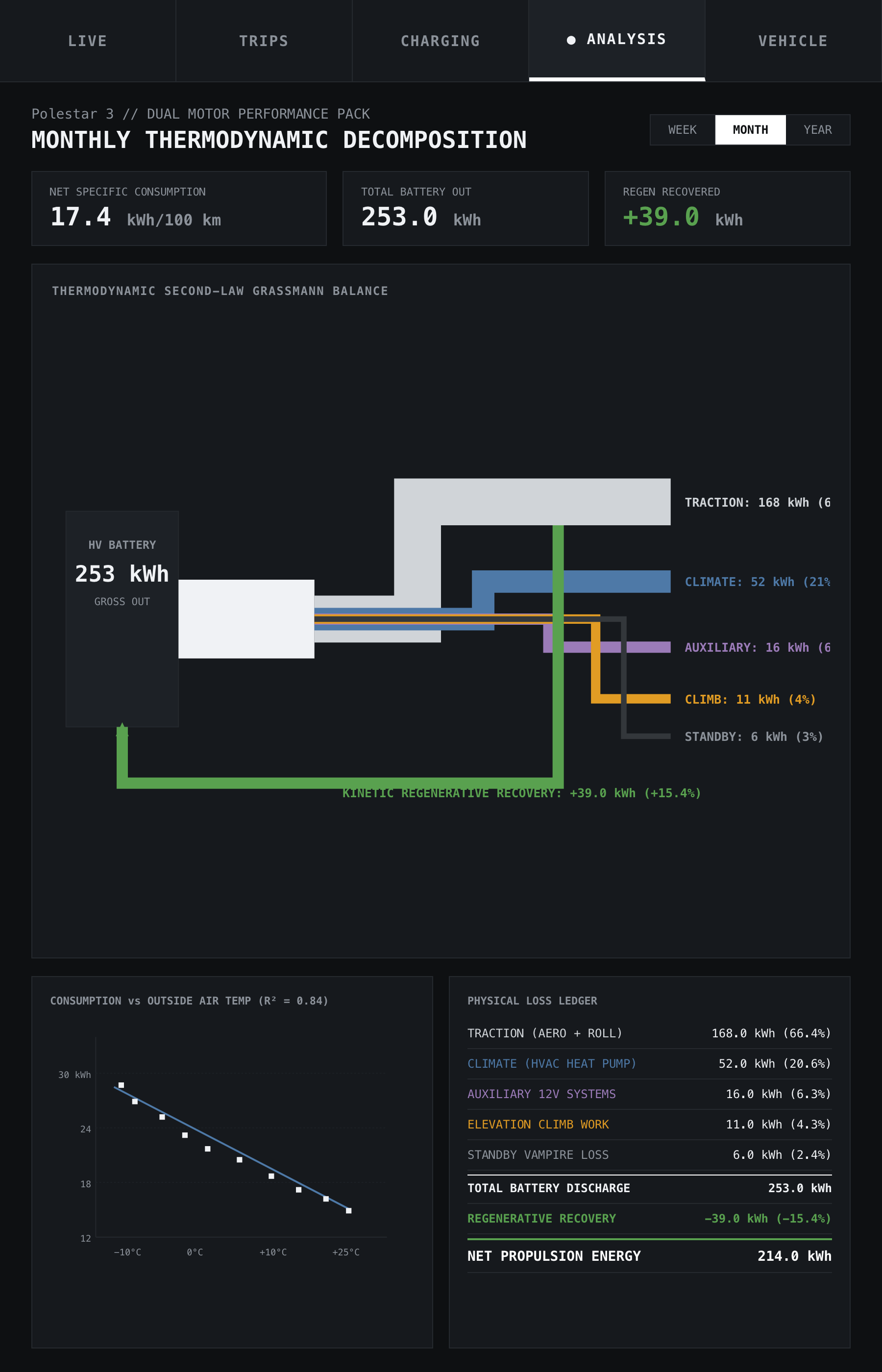
Optimized for modern vertical center consoles
Designed specifically for portrait vehicle displays such as the 14.5" Polestar 3/4 and Volvo EX90. Vertical flow topology stacks top navigation tabs, center-stage Sankey balance, and a dual telemetry deck for immediate visual inspection.
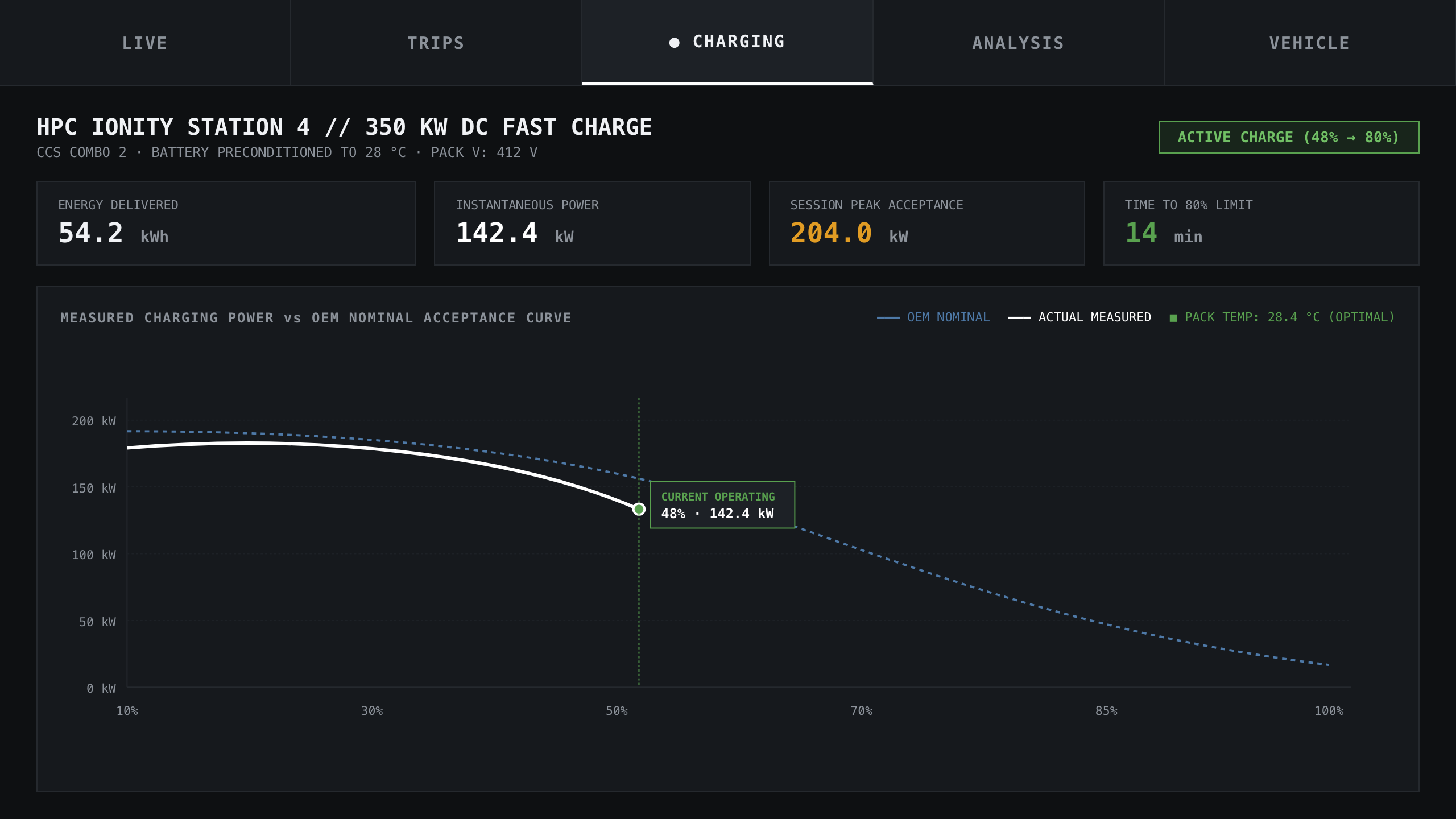
High-power charging telemetry and thermal curves
When plugged into a 350 kW DC fast charger or AC wallbox, Exergy monitors instantaneous pack acceptance power against the vehicle's nominal OEM charging curve. Tracks battery temperature window, cooling loop thermal draw, and grid-to-battery exergy destruction.
Deep post-trip telemetry on your phone
Review drives from your desk or sofa without draining vehicle battery.
The companion app features a vector Sankey mode switcher (FLOW | TRACE | MAP), multi-channel DAQ strip charts (Power, Speed, Elevation, HVAC), and one-tap open data exports.
Local-first by construction. Zero account required.
Most connected car apps upload raw, unencrypted GPS tracks to corporate clouds to profile drivers and resell telemetry. Exergy is built on a strict zero-knowledge foundation: the vehicle is the primary data sovereign, pairing is purely optical, and sync payloads are encrypted with XChaCha20-Poly1305 before leaving the car.
1. Zero Cloud Account
The in-vehicle app works completely without registration, email address, password, or cloud profile. The internal flash storage on your car holds the authoritative, full-resolution database.
2. Optical QR Pairing
Pairing generates an ephemeral 256-bit symmetric pre-shared key (PSK) and Ed25519 keypair inside the vehicle in park. Your phone camera reads the optical QR code directly. No account server is ever involved in key exchange.
3. XChaCha20-Poly1305 E2EE
All sync payloads are encrypted with XChaCha20-Poly1305 (192-bit extended nonce). Hardware-backed keys are held strictly in Android Keystore / Apple Keychain.
4. Blind Mailbox Relay
When cloud sync is enabled, the relay server acts as an untrusted blind mailbox. The server cannot inspect routes, speeds, energy usage, timestamps, or vehicle VIN, and automatically purges blobs after delivery.
5. In-Cabin Offline Wi-Fi
Reject the cloud completely: when your companion phone connects to the in-vehicle Wi-Fi hotspot, Exergy discovers the vehicle via mDNS and syncs over pinned TLS 1.3. Zero bytes leave the car cabin.
6. Open Data Export
Your data belongs to you. Export complete 1 Hz telemetry or aggregated summaries at any time to standard CSV, structured JSON Schema, or GPX tracks with custom power extensions.
Built for Google built-in (AAOS) vehicles
Exergy reads standard automotive properties via the Android Automotive OS Car API (CarPropertyManager).
It supports vehicles running Android Automotive OS with Google built-in, with graceful degradation when an OEM restricts specific properties.
| OEM / Manufacturer | Supported Vehicle Models | Target OS Version | Exposed VHAL Signals | Integration Status |
|---|---|---|---|---|
| Polestar | Polestar 2, Polestar 3, Polestar 4 | AAOS 11 / 12 / 13 / 14 | SPEED HV_BATT_V/I SOC_PCT EXT_TEMP HVAC_LOAD GEAR | TESTED & VERIFIED |
| Volvo Cars | EX30, EX90, XC40 / C40 Recharge | AAOS 11 / 12 / 13 | SPEED HV_BATT_V/I SOC_PCT EXT_TEMP GEAR HVAC_EST ≈ | TESTED & VERIFIED |
| Renault | Megane E-Tech, Scenic E-Tech | OpenR Link (AAOS 12) | SPEED HV_BATT_V/I SOC_PCT EXT_TEMP HVAC_EST ≈ | COMPATIBLE |
| Ford Motor Co. | Mustang Mach-E, F-150 Lightning (Digital Exp) | Ford Digital Experience | SPEED HV_BATT_V/I SOC_PCT EXT_TEMP | COMPATIBLE |
| General Motors | Chevrolet Blazer EV, Equinox EV, Cadillac LYRIQ | Ultifi Platform (AAOS) | SPEED HV_BATT_V/I SOC_PCT EXT_TEMP | COMPATIBLE |
| Honda | Prologue EV | Google built-in | SPEED HV_BATT_V/I SOC_PCT | COMPATIBLE |
Open source multiplatform engineering
Built with Kotlin Multiplatform (KMP). A unified shared domain model, physical thermodynamic engine, crypto envelope, and SQLDelight persistence engine powering native automotive and phone frontends.
Shared KMP Core Architecture
The core module compiles to Java bytecode for Android / AAOS and native machine code (Objective-C/Swift framework) for iOS, guaranteeing identical physics attribution across all devices.
Automotive Flash Storage Preservation
Automotive eMMC/UFS memory has strict lifecycle write limits. Exergy batches 10 Hz high-rate CAN telemetry in volatile memory, downsamples at 1 Hz for disk commits, and applies write-ahead write mitigation.